A Hybrid Robust Estimator Compared to Some Conventional Robust Estimators in Analyzing Concrete Compressive Strength Dataset
Keywords:
Robust estimation, Non linear regression, Adaptive huber loss, Heavy-tailed errors, Concrete compression strengthAbstract
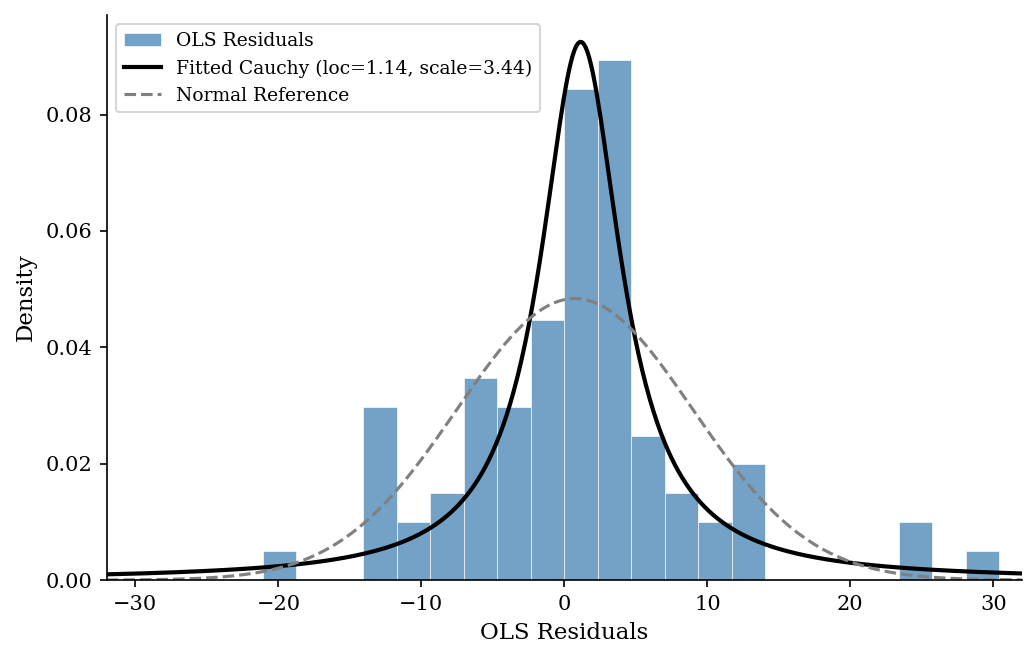
Ordinary least squares estimation of nonlinear regression models is highly sensitive to outliers, high-leverage observations, and departures from error normality, often this is common in engineering dataset. This paper compares the performance of four conventional single robust estimators (M-estimation, MM-estimation, the classical Non-Adaptive Huber estimator (NAH), and L₁ regression) against a hybrid robust estima-tor, M-Estimation with Adaptive Huber Loss (MAHL), on the exponential nonlinear regression model relating concrete compressive strength to eight mixture-design and curing-age predictors. Using the Concrete Compressive Strength (CCS) dataset (n = 86), a four-step diagnostic framework was applied and returned the following outcomes; firstly, Shapiro-Wilk normality test which rejected the normality of the ordinary least squares residuals; secondly, Kolmogorov-Smirnov goodness-of-fit test which identified a heavy-tailed Cauchy error distribution; thirdly, a standardized residual screening which flagged 4.7% response-space contamination; and fourthly, Mahalanobis distance leverage detection which flagged 8.1% predictor-space leverage. Both contamination rates falling below the 20% threshold established in prior simulation work. Consistent with the corresponding decision rule, it was found that MAHL achieved the lowest Mean Squared
Error (MSE) value of 18.270 compared to the conventional MM, L₁, NAH, and M estimators with progres-sively higher MSE values. These findings confirm that MAHL provides superior predictive accuracy over the conventional robust alternatives for nonlinear regression models with non-normal, heavy-tailed errors, and moderate contamination.