
Analysis of PAHs Uptake and Bioaccumulation in Maize (Zea mays L.) from Jalingo Dumpsites in Taraba State

Authors

  • Salvation Nogindick Ephesian
    Department of Chemistry, Faculty of Physical Sciences, Federal University Wukari, Nigeria
  • John Odiba Oko
    Department of Chemistry, Faculty of Physical Sciences, Federal University Wukari, Nigeria
  • Emmanuel Amuntse Yerima
    Department of Chemistry, Faculty of Physical Sciences, Federal University Wukari, Nigeria

Keywords:

Bioaccumulation, PAHs, Transfer Factors, Dumpsite, Zea mays L.

Abstract

This study assessed Polycyclic Aromatic Hydrocarbons (PAHs) uptake and bioaccumulation in maize (Zea mays L.) grown on dumpsite soils in Jalingo, Taraba State, Nigeria. The collection of soil samples from three dumpsites and monthly sampled maize stems and leaves over a three-month growth period was performed. Gas Chromatography-Mass Spectrometry (GC-MS) analyzed thirteen PAH compounds, while Transfer Factors (TF) and Bioaccumulation Factors (BAF) evaluated pollutant movement. The results showed a mean total PAH concentration of 0.1008 ± 0.0143 mg/kg in the soil, with benzo[g,h,i]perylene being the highest (0.0715 ± 0.0127 mg/kg). Total PAH levels in both stems and leaves increased progressively from month one to month three. Analysis of variance (ANOVA) and Duncan tests revealed statistically significant variations (p < 0.05) for naphthalene, 2-methylnaphthalene, acenaphthene, and fluorene in the leaves, confirming active uptake during plant growth. Crucially, both TF and BAF values exceeded one for several PAHs, especially 2-methylnaphthalene, pyrene, and fluoranthene, proving that maize efficiently extracts and concentrates these toxins from the ground. Ultimately, these findings show that dumpsite farming allows contaminants to enter the food chain, posing potential health risks to local farmers and consumers. To protect public health and the environment, the study highlights a need for regular environmental monitoring, better waste management, and restrictions on growing food crops on contaminated dumpsites. Options are available to shorten the text further, adjust the focus to highlight specific statistical results, or adapt the summary for a different target audience.
 

DOI: https://doi.org/10.5281/zenodo.23708301

Dimensions

[1] Umar H. M., Nyameh J., & Jauro J. Agricultural Management Strategy on Food Security in Taraba State. Journal of Biology, Agriculture and Healthcare 2014, 4(8), 29-31. https://www.iiste.org/Journals/index.php/JBAH/article/view/12281

[2] Abdel-Shafy H. I. & Mansour M. S. M. A Review on Polycyclic Aromatic Hydrocarbons: Source, Environmental Impact, Effect on Human Health and Remediation. Egyptian Journal of Petroleum 2016, 25, 107-123. https://doi.org/10.1016/j.ejpe.2015.03.011

[3] Ferrarese E., Andreoottola G., & Oprea I. A. Remediation of PAH-contaminated Sediments by Chemical oxidation. Journal of Hazardous Materials 2008, 152(1), 128-139. https://doi.org/10.1016/jhazmat.2007.06.080

[4] Ravi M. B., Srinivas S., Swamy K. N. R., Anupama A., Roy A., Gowrav M. P., Achar R. R. Influence of Domestic Exposure to Polycyclic Aromatic Hydrocarbons on Women's Periconceptional Stage and Associated Risk of Oral Cleft in Offspring. Journal Pharmaceutical Bio allied Science 2022, 14(1), 589-594. https://doi.org/10.4103/jpbs.jpbs_659_21.

[5] Sampaio G. R., Guizellini G. M., da Silva S. A., de Almeida A. P., Pinaffi-Langley A. C. C., Rogero M. M., de Camargo A. C., & Torres E. A. F. S. Polycyclic Aromatic Hydrocarbons in Foods: Biological Effects, Legislation, Occurrence, Analytical Methods, and Strategies to Reduce Their Formation. International journal of molecular sciences 2021, 22(11), 6010. https://doi.org/10.3390/ijms22116010.

[6] Parra Y. J., Oloyede O. O., Pereira G. M., de Almeida, L. P. H. A., da Silva C. S.E, Morenikeji O. A., & de Castro V. P. Poly-cyclic aromatic hydrocarbons in soils and sediments in Southwest Nigeria. Environmental Pollution 2020, 259, 113732. https://doi.org/10.1016/j.envpol.2019.113732.

[7] Khan A. H., Li J., Zeng J., & Zhang Y. Distribution, sources, and health risk assessment of polycyclic aromatic hydrocarbons (PAHs) in agricultural soils near an industrial city, Northwest China. Environmental Research 2020, 187, 109673. https://doi.org/10.1016/j.envres.2020.109673

[8] Zhang S., Yao H., Lu Y., Yu X., Wang J., Sun S., Liu M., Li D., Li Y. F., & Zhang D. Uptake and translocation of polycyclic aromatic hydrocarbons (PAHs) and heavy metals by maize from soil irrigated with wastewater. Scientific Reports 2017, 7(1), 12165. https://doi.org/10.1038/s41598-017-12437-w

[9] Ali M., Song X., Ding D., Wang Q., Zhang Z., & Tang Z. Bioremediation of PAHs and heavy metals co-contaminated soils: Challenges and enhancement strategies. Environmental pollution 2022, 260, https://doi.org/10.1016/j.envpol.2021.118686

[10] Oko J. O, & Okoye C. Evaluation of the PAH contamination from smoked fish obtained from Northern Nigeria. Advances in Food Science and Engineering 2020, 4(1), 001. https://doi.ogr/10.22606/afse.2020.41001.

[11] Orunonye E. D. Assessment of the level of awareness of the effects of climate change among students of tertiary institutions in Jalingo Metropolis, Taraba State Nigeria. Journal of geography and regional planning 2011, 4(9), 513–517. https://doi.org/10.5897/JGRP.9000012

[12] Tsue P., Daniel A., & Teran A. Agricultural Land Use Practices and Intensity of Environmental Degradation in North Central Nigeria's Arable Farming Landscape. Journal of Agripreneurship and Sustainable Development 2021, 4(3), 2651-6144. https://doi.org/10.59331/jasd.v4i3.242.

[13] Jonathan R. & Fibi W. Analysis of Vegetable Marketing Determinants and Performance in Taraba State, Nigeria. International Journal of Research and Innovation in Social Science 2023, VII. 1648-1666. https://doi.org/10.47772/IJRISS.2023.701127.

[14] Musa M. I., Sanusi A., Wahab S. & Ogunkolu A. B. People's Perception of Land Use Changes Along the Flood Plain of River Gwoi in Jalingo, Taraba State, Nigeria 2022, 2(3) 438-454. https://gsujournals.com.ng/gojges/index.php/gojges/article/view/86

[15] Ekanem A. N., Osabor V. N. & Ekpo B. O. Polycyclic aromatic hydrocarbons (PAHs) contamination of soils and water around automobile repair workshops in Eket metropolis, AkwaIbom State, Nigeria. SN Applied Sciences 2019, 1, 447. https://doi.org/10.1007/s42452-019-0397-4

[16] Lau E. V., Gan S. & Ng H. K. Extraction techniques for polycyclic aromatic hydrocarbons in soils. International Journal of An-alytical Chemistry 2010, 1–9. https://doi.org/10.1155/2010/398381

[17] Chen Q., Zheng T., Bassig B., Cheng Y., Leaderer B., Lin S., Holford T., Qiu J., Zhang Y., Shi K., Zhu Y., Niu J., Li Y., Guo H., Hu X. & Jin Y. Prenatal Exposure to Polycyclic Aromatic Hydrocarbons and Birth Weight in China. Open Journal of Air Pollution 2014, 3, 100-110. https://doi.org/10.4236/ojap.2014.34010.

[18] Okechukwu V. U., Omokpariola D. O., Onwukeme V. I., Nweke E. N., & Omokpariola P. L. Pollution investigation and risk assessment of polycyclic aromatic hydrocarbons in soil and water from selected dumpsite locations in rivers and Bayelsa State, Nigeria. Environmental Analysis, Health and Toxicology 2021, 36(4), e2021023. https://doi.org/10.5620/eaht.2021023.

[19] Adedosu T. A, Adeniyi O. K., & Adedosu H. O. Distribution, Sources and Toxicity Potentials of Polycyclic Aromatic Hy-drocarbons in Soils around the Vicinity of Balogun-Birro Dumpsite of Oshogbo, Nigeria. Malaysian Journal of Analytical Sciences 2015, 19(3), 636-648. https://mjas.analis.com.my/wp-content/uploads/2018/11/Adedosu_19_3_20.pdf

[20] International Agency for Research on Cancer (IARC). IARC Monographs on the Evaluation of Carcinogenic Risks to Humans 2020, Volume 120: Benzene. https://www.iarc.who.int/news-events/iarc-monographs-volume-120-benzene/

[21] Zhang X., Lu W., Xu L., Wu W., Sun B., Fan W., Zheng H., & Huang J. Environmental Risk Assessment of Polycyclic Aromatic Hydrocarbons in Farmland Soils near Highways: A Case Study of Guangzhou, China. International Journal of Environmental Research and Public Health 2022, 19(16), 10265. https://doi.org/10.3390/ijerph191610265.

[22] Wang W., Yang Q., Han F., Xu Y., Yu D., & Pan X. Polycyclic aromatic hydrocarbons in the atmosphere-plant system: Con-centrations, distributions, and air-vegetation exchange. Environmental Pollution 2018, 234, 497-505. https://doi.org/10.1016/j.envpol.2017.11.055.

[23] Liu X., Sun Y., Chen J., Li Y., Wang R., Zheng X., & Lv Y. Uptake and translocation of polycyclic aromatic hydrocarbons (PAHs) by different plant species in a contaminated soil. Environmental Pollution 2018, 233, 1140-1147. https://doi.org/10.1016/j.envpol.2017.10.038

[24] Oko J. O., Yerima E. A., Shintema A., Yakubu S. & Bilyaminu, H. Polycyclic Aromatic Hydrocarbon (PAHs) Levels in Treated Spent Engine Oil Contaminated Soil from Auto Mechanic Workshop Site in Wukari, Nigeria. Lafia Journal of Scientific and In-dustrial Research 2024, 2(1), 308 https://doi.org/10.62050/ljsir2024.v2n1.308.

[25] Tubotu F. K., Akporhonor E. E., & Agbaire P. O. Growth and cadmium and nickel uptake of maize in contaminated soil. International Journal of Scientific Reports 2024, 10(5), 141-147. https://doi.org/10.18203/issn.2454-2156.intJsciRep20240977

[26] Odei K. A., Afedzie R. A., Kwakye K. A., Opeolu B. O., & Akoto, O. Distribution, sources, and health risk assessment of PAHs in soils from Ghana cocoa farms. Scientific African 2019, 4, e00091. https://doi.org/10.1016/j.sciaf.2019.e00091.

[27] Okoro E. A., Abba C. O., Agbazue O., Okoro H. K., & Ekwere L. I. Health risk assessment of polycyclic aromatic hydrocar-bons in selected food crops from farmlands in an oil-producing community of Nigeria. Environmental Research 2021, 194, 110665. https://doi.org/10.1016/j.envres.2021.11066.

[28] World Health Organization. WHO global air quality guidelines: Particulate matter (PM2.5 and PM10), ozone, nitrogen dioxide, sulfur dioxide and carbon monoxide. Geneva 2021, 1. Available from: https://www.ncbi.nlm.nih.gov/books/NBK574597/

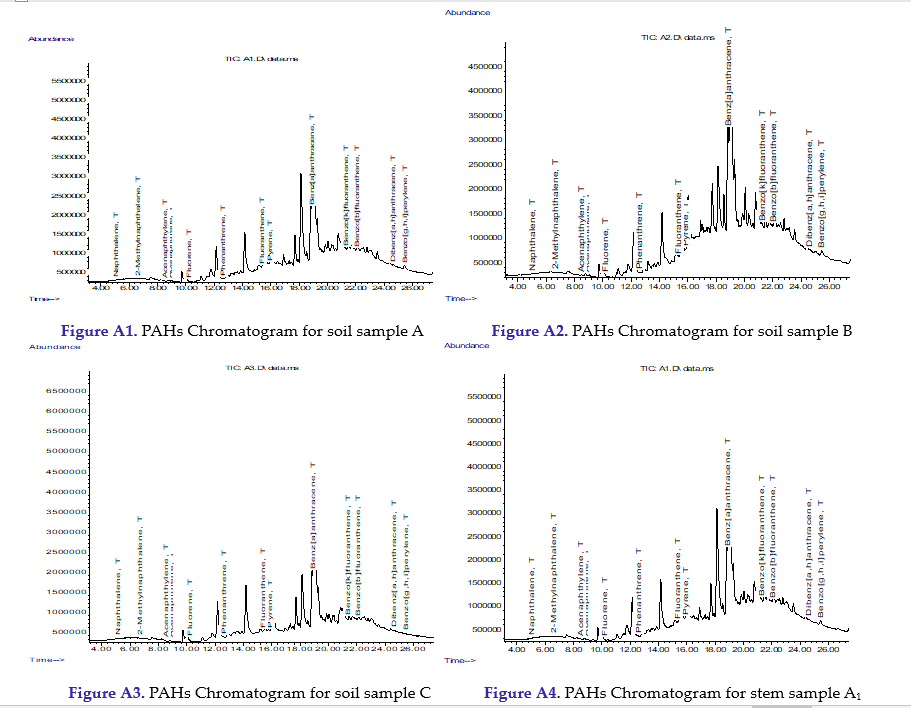
Sample of Chromatogram Plots for PAHs

Published

2026-10-29

How to Cite

Analysis of PAHs Uptake and Bioaccumulation in Maize (Zea mays L.) from Jalingo Dumpsites in Taraba State. (2026). Frontiers in Physical and Applied Sciences (FIPAS), 1(1), 34-47. https://journals.fuwukari.org.ng/index.php/fpas/article/view/24

How to Cite

Analysis of PAHs Uptake and Bioaccumulation in Maize (Zea mays L.) from Jalingo Dumpsites in Taraba State. (2026). Frontiers in Physical and Applied Sciences (FIPAS), 1(1), 34-47. https://journals.fuwukari.org.ng/index.php/fpas/article/view/24