Chemical Composition and Antimicrobial Potential of n-hexane and Methanol Extracts of Benue Propolis

Authors

  • Ifeoma Sandra Iyen
    Department of Chemistry, Faculty of Physical Sciences, Federal University Wukari, Nigeria.
  • Daniel Tarungwa
    Department of Chemistry, Faculty of Physical Sciences, Federal University Wukari, Nigeria.
  • Benedict Ayomanor
    Department of Science Laboratory Technology, Federal University of Petroleum Resources, Effurun, Nigeria.
  • Humphrey Sam Samuel
    Department of Chemistry, Faculty of Physical Sciences, Federal University Wukari, Nigeria.

Keywords:

Propolis, Maceration, Antimicrobial activity, Chemical Composition, GC-MS

Abstract

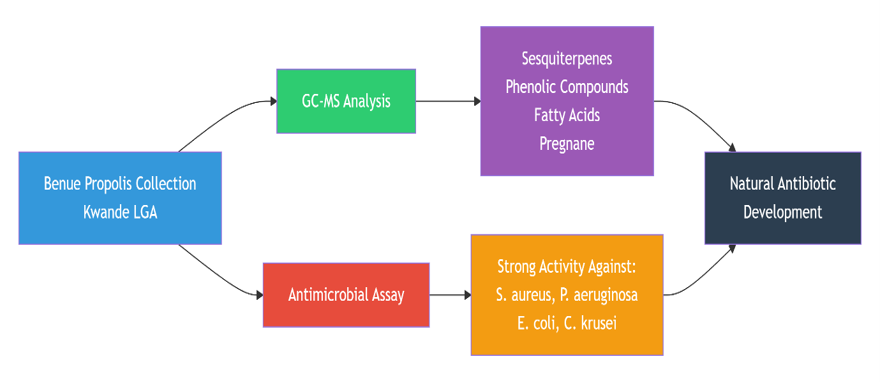
Propolis is a resinous material made by honey bees for protecting their hives against microbial attack. Propolis sample was collected from Kwande Local Government Area of Benue State. This study investigated the chemical constituents and antimicrobial activity of the crude extracts using gas chromatography–mass spectrometry (GC–MS) and in vitro susceptibility assays. Propolis sample was extracted using n-hexane, ethyl acetate and methanol. Antimicrobial evaluation against nine bacterial and four fungal strains demonstrated broad-spectrum activity significantly for the n-hexane and methanol extracts, with significant inhibition of Staphylococcus aureus (25±0.03 mm, 20±0.04 mm) and Pseudomonas aeruginosa (21±0.03 mm, 17±0.01 mm) by n-hexane, and methanol extracts, respectively. Moderate activity was observed against Escherichia coli (18±0.01 mm, 20±0.04 mm). The minimum inhibitory and bactericidal concentration (MIC/MBC) of the crude extracts of the inhibited bacteria ranged from 1.57 – 25 mg/mL. Significant antifungal activity was recorded against Candida krusei (24±0.02 mm) with the minimum fungicidal concentration of 1.57 mg/mL. GC–MS analysis of the extracts revealed a complex mixture of hydrocarbons, fatty acids, esters, alcohols, terpenoids, phenolics, and steroidal compounds. The methanol extract showed majorly 9,12-octadecadienoic acid (51.65%), alongside hexadecanoic acid (14.30%), glycerin (7.73%) and hydroquinone. Batilol and pregnane were reported for the first time in Nigerian Propolis. N-hexane extract was characterized by hydrocarbons and sesquiterpenes. These findings demonstrate that Benue Propolis possesses a phytochemical profile with sig-nificant antimicrobial potential, which can serve as promising source of bioactive compounds for therapeutic and drug development applications.


DOI: https://doi.org/10.5281/zenodo.21340628


Dimensions

[1] Igoli, J. Nigerian Propolis: An Unknown and Untapped Natural and Economic Resource. Journal of the Chemical Society of Nigeria 2020, 5(1), 34–37. https://doi.org/10.13140/RG.2.2.21369.29284.

[2] Moise, A. R. & Bobiş, O. Baccharis dracunculifolia and Dalbergia ecastophyllum, Main Plant Sources for Bioactive Properties in Green and Red Brazilian Propolis. Plants 2020, 9(11), 1619. https://doi.org/10.3390/plants9111619.

[3] Popova, M., Trusheva, B., & Bankova, V. In Gums, Resins and Latexes of Plant Origin: Chemistry, Biological Activities and Uses; Murthy, H. N., Ed.; Springer International Publishing: Cham, 2021; pp. 1–33. https://doi.org/10.1007/978-3-030-91378-6.

[4] Grinn-Gofroń, A., Kołodziejczak, M., Hrynkiewicz, R., Lewandowski, F., Bębnowska, D., Adamski, C., & Niedźwiedzka-Rystwej, P. Antimicrobial Potential of Bee-Derived Products: Insights into Honey, Propolis and Bee Venom. Pathogens 2025, 14(8), 780. https://doi.org/10.3390/pathogens14080780.

[5] de Oliveira, M. S., Cruz, J. N., Ferreira, O. O., Pereira, D. S., Pereira, N. S., Oliveira, M. E. C., & Andrade, E. H. A. Chemical Composition of Volatile Compounds in Apis mellifera Propolis from the Northeast Region of Pará State, Brazil. Molecules 2021, 26(11), 3462. https://doi.org/10.3390/molecules26113462.

[6] Pino, J.A., Marbot, R., Delgado, A., Zumárraga, C. and Sauri, E., 2006. Volatile constituents of propolis from honey bees and stingless bees from Yucatan. Journal of Essential Oil Research, 18(1), pp.53-56. https://doi.org/10.1080/10412905.2006.9699384.

[7] Dezmirean, D. S., Paşca, C., Moise, A. R., & Bobiş, O. Plant Sources Responsible for the Chemical Composition and Main Bio-active Properties of Poplar-Type Propolis. Plants 2021, 10(1), 22. https://doi.org/10.3390/plants10010022.

[8] Šturm, L. & Ulrih, N. P. Advances in the Propolis Chemical Composition between 2013 and 2018: A Review. eFood 2020, 1(1), 24–37. https://doi.org/10.2991/efood.k.191029.001.

[9] Šuran, J., Cepanec, I., Mašek, T., Radić, B., Radić, S., Tlak Gajger, I., & Vlainić, J. Propolis and Its Mechanism of Action in Dia-betic Wound Healing. Molecules 2021, 26(10), 2930. https://doi.org/10.3390/molecules26102930.

[10] Kasote, D., Bankova, V., & Viljoen, A. M. Propolis: A Review of Its Chemical Composition and Biological Activities. Phyto-chemistry Reviews 2022, 21(6), 1887–1911. https://doi.org/10.1007/s11101-022-09816-1.

[11] Bastos, J.K. and Arruda, C., 2022. Chemistry and biological activities of phenolic compounds from Baccharis Genus. In Bac-charis: From Evolutionary and Ecological Aspects to Social Uses and Medicinal Applications (pp. 305-328). Cham: Springer International Publishing. https://doi.org/10.1007/978-3-030-83511-8_12.

[12] Qiao, J., Wang, Y., Zhang, Y., Kong, L., & Zhang, H. Recent Advances in the Extraction, Chemical Composition, and Biological Activities of Propolis. Foods 2023, 12(12), 2304. https://doi.org/10.3390/foods12122304.

[13] Bozkuş, T. N. Evaluation of Quality Parameters and Bioactive Characteristics of Turkish Propolis Samples. European Food Research and Technology 2026, 252(1), 8. https://doi.org/10.1007/s00217-025-04970-0.

[14] Florek, J., Dybiak, P., Bartoszek, M., Grzegorzak, E., Krawczyk, O., Minas, J., & Harnicki, P. Physical and Physiological Profiles of Athletes. Quality in Sport 2026, 50, 67635. https://doi.org/10.12775/QS.2026.50.67635.

[15] Salatino, A. Perspectives for New Applications of Propolis in Medicine and Industry. Molecules 2022, 27(14), 4594. https://doi.org/10.3390/molecules27144594.

[16] Wieczorek, P. P., Hudz, N., Yezerska, O., Horčinová-Sedláčková, V., Shanaida, M., Korytniuk, O., & Jasicka-Misiak, I. Chemi-cal Profile and Antioxidant Activity of Propolis Extracts. Molecules 2022, 27(5), 1600. https://doi.org/10.3390/molecules27051600.

[17] Hossain, R., Quispe, C., Khan, R. A., Saikat, A. S. M., Ray, P., Ongalbek, D., & Cho, W. C. Therapeutic Potential of Propolis and Its Chemical Constituents. Chinese Medicine 2022, 17(1), 100. https://doi.org/10.12991/jrespharm.1814425.

[18] Omar, R., Igoli, J. O., Zhang, T., Gray, A. I., Ebiloma, G. U., Clements, C. J., & Watson, D. G. Chemical Characterisation of Ni-gerian Propolis Samples and Their Activity Against Trypanosoma brucei. Scientific Reports 2017, 7(1), 923. https://doi.org/10.1038/s41598-017-01038-2.

[19] Blicharska, N. & Seidel, V. In Progress in the Chemistry of Organic Natural Products; Kinghorn, A. D., Falk, H., Gibbons, S., Asakawa, Y., Eds.; Springer International Publishing: Cham, 2019; Volume 109, pp. 415–450. https://doi.org/10.1007/978-3-030-12858-6.

[20] Dvykaliuk, R.M. and Adamchuk, L.O., 2021. Development of a propolis collecting device. Animal Science and Food Technol-ogy, 12(3), pp.76-88. https://doi.org/10.31548/animal2021.03.007.

[21] Lazaridis, D.G., Kitsios, A.P., Koutoulis, A.S., Malisova, O. and Karabagias, I.K., 2024. Fruits, spices and honey phenolic com-pounds: a comprehensive review on their origin, methods of extraction and beneficial health properties. Antioxidants, 13(11), p.1335. https://doi.org/10.3390/antiox13111335.

[22] Guzelmeric, E., Yuksel, P.I., Yaman, B.K., Sipahi, H., Celik, C., Kırmızıbekmez, H., Aydın, A. and Yesilada, E., 2021. Compari-son of antioxidant and anti-inflammatory activity profiles of various chemically characterized Turkish propolis sub-types: Which propolis type is a promising source for pharmaceutical product development?. Journal of Pharmaceutical and Biomed-ical Analysis, 203, p.114196. https://doi.org/10.1016/j.jpba.2021.114196.

[23] Mohtar, L. G., Rodríguez, S. A., & Nazareno, M. A. Comparative Study on Antioxidant Properties of Different Propolis Ex-tracts. Journal of the Science of Food and Agriculture 2018, 98(9), 3409–3415. https://doi.org/10.1002/jsfa.8845.

[24] Hossain, T. J. Antimicrobial and Therapeutic Properties of Propolis and Its Major Bioactive Components. European Journal of Microbiology and Immunology 2024, 14(2), 97–115. https://doi.org/10.1556/1886.2024.00035.

[25] Kelly, K. & Bell, S. Differentiation of Propolis Samples Using Attenuated Total Reflectance Infrared Spectroscopy. Forensic Chemistry 2018, 7, 10–18. https://doi.org/10.1016/j.forc.2022.100459.

[26] Ranjan, S., Chaitali, R.O.Y. and Sinha, S.K., 2023. Gas chromatography–mass spectrometry (GC-MS): A comprehensive review of synergistic combinations and their applications in the past two decades. Journal of Analytical Sciences and Applied Bio-technology, 5(2), pp.72-85. https://doi.org/10.48402/IMIST.PRSM/jasab-v5i2.40209.

[27] Iyen, I. S., Edeghor, U. O., Anyam, J. V., Samuel, H. S., Adindu, E. A., Tor-Anyiin, T. A., & Igoli, J. O. Chemical Profiling and Biological Evaluation of Nigerian Propolis. Scientific Reports 2026, submitted. https://doi.org/10.1038/s41598-025-30775-y.

[28] Peixoto, S., Nascimento, A. P. S., Vicente, C., & Barros, A. N. Microencapsulation of Propolis Extracts and Evaluation of Bioac-tive Compounds Stability. Applied Sciences 2025, 15(18), 9928. https://doi.org/10.3390/app15189928.

[29] Ayna, A. & Nerway, F. Determination of Phenolic Compounds in Propolis Extracts by Liquid Chromatography. Biomedical Chromatography 2026, 40(1), e70291. https://doi.org/10.1002/bmc.70291.

[30] Rouvier, F., Abou, L., Wafo, E., & Brunel, J. M. Antibacterial and Synergistic Activity of Propolis Extracts Combined with Conventional Antibiotics. Current Issues in Molecular Biology 2025, 47(3), 162. https://doi.org/10.3390/cimb47030162.

[31] Dominguez-Verano, P., Jacobo-Herrera, N., Castell-Rodríguez, A., Canales-Alvarez, O., Canales-Martinez, M. M., & Rodri-guez-Monroy, M. A. Biological Properties and Chemical Characterization of Mexican Red Propolis. Antioxidants 2025, 14(1), 65. https://doi.org/10.3390/antiox14010065.

[32] Helmy, A.K., Sidkey, N.M., Abdel-Aziz, M.M. et al. Chemical composition of Egyptian propolis and studying its antimicrobial activity and synergistic action with honey against some multidrug-resistant uropathogens. Sci Rep 15, 17484 (2025). https://doi.org/10.1038/s41598-025-00773-1.

[33] Vind, J., Engelsen, S.B., Jørgensen, H.M., Antvorskov, J.C., Josefsen, K. and Aru, V., 2026. Comparative 1H NMR Metabolom-ics Between Scandinavian Propolis and Australian Propolis: The Quest to Identify Radical Scavenging Compounds. Magnetic Resonance in Chemistry. https://doi.org/10.1002/mrc.70082.

[34] Béji-Srairi, R., Younes, I., Snoussi, M., Yahyaoui, K., Borchard, G., Ksouri, R., Frachet, V. and Wided, M.K., 2020. Ethanolic extract of Tunisian propolis: chemical composition, antioxidant, antimicrobial and antiproliferative properties. Journal of Apicultural Research, 59(5), pp.917-927. https://doi.org/10.1080/00218839.2020.1732572.

[35] Przybyłek, I. & Karpiński, T. M. Antibacterial Properties of Propolis. Molecules 2019, 24(11), 2047. https://doi.org/10.3390/molecules24112047.

[36] Bozkuş, T.N., 2025. The evolution of propolis research: A bibliometric analysis. European Journal of Integrative Medicine, 78, p.102518. https://doi.org/10.1016/j.eujim.2025.102518.

[37] Grange, J. M. & Davey, R. W. Antibacterial Properties of Propolis. Journal of the Royal Society of Medicine 1990, 83(3), 159–160. https://doi.org/10.1177/014107689008300310.

[38] Rivera-Yanez, N., Rivera-Yanez, C.R., Pozo-Molina, G., Mendez-Catala, C.F., Reyes-Reali, J., Mendoza-Ramos, M.I., Men-dez-Cruz, A.R. and Nieto-Yanez, O., 2021. Effects of propolis on infectious diseases of medical relevance. Biology, 10(5), p.428. https://doi.org/10.3390/biology10050428.

Graphical abstract

Published

2026-07-17

How to Cite

Chemical Composition and Antimicrobial Potential of n-hexane and Methanol Extracts of Benue Propolis. (2026). Frontiers in Physical and Applied Sciences (FIPAS), 1(1), 1-8. https://journals.fuwukari.org.ng/index.php/fpas/article/view/6

How to Cite

Chemical Composition and Antimicrobial Potential of n-hexane and Methanol Extracts of Benue Propolis. (2026). Frontiers in Physical and Applied Sciences (FIPAS), 1(1), 1-8. https://journals.fuwukari.org.ng/index.php/fpas/article/view/6